Showing posts with label Politics. Show all posts

Wednesday, September 9, 2009

Inmegen: ¿good or bad news?

By Martín Bonfil Olivera
Published in
Milenio Diario, September 9th, 2009


On August 26 mexican newspaper MILENIO Diario reported that the Federal budget for 2010 will feature a 47% cut to the National Institute of Genomic Medicine (Inmegen). 120 million pesos less (from 252 in 2009 to 132 in 2010).


The natural reaction would be anger, sadness or resignation in view of another example of the lack or value our government assigns to scientific research. Inmegen would be an isolated step in the right direction, and this cut is a worrying symptom against which we should protest. This is what Gerardo Jiménez, the Institute's head, did when he declared that the decision "puts several projects of scientific research related to the study of chronic and degenerative diseases at risk".


But there's another side of the coin. Inmegen has been questioned from several fronts. The most serious one is about corruption in the construction of their building, started in 2006 and today still unfinished and abandoned. Several damages to the Federal Treasure were identified, worth 33 million pesos, as well as overexpenses for 78 million (111 million in total). Its administrative director was fined with almost 3 million and incapacitated for 10 years by the recently disappeared Public Function Ministry (the architect responsible of the building was also incapacitated, for 15 years).


And the science being done at Inmegen also has its own problems. Their relatively modest study of "the Mexican genome" was artificially blown up to turn it, according to Mexican president Felipe Calderón, into "our entrance into XXI century medicine". The still distant benefits of genomic medicine have been exaggerated wildly. Its capacity for sequencing (reading) genomes, under-used during the influenza epidemic, has now been exceeded by the National University (UNAM), which –even with its ever-present limitations and its budget problems has just inaugurated superior installations. And its reductionist approach, patent in talk of "Mexican" or "sonoran" (from the mexican state of Sonora) genomes, is biologically and even ethically questionable.


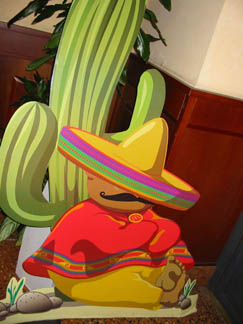
The traditional image of Mexicans is one of lazyness: a guy with a big "sombrero" and a sarape sleeping against a cactus. I think our real problem is one of perseverance: when necessary, we are able to start taking actions to solve our problems.


But sadly, we do not follow up. We build the road but don't give it maintenance. We created a Federal Elections Institute, but we didn't protect it so it wouldn't fall apart and loose all credibility. We created the Inmegen, but we don't guarantee it an appropriate building, personnel nor budget, and we don't ensure that budget is spent honestly.


What a waste.

(translated by Adrián Robles Benavides)

To receive Science for pleasure weekly
in your email, subscribe her


Tuesday, September 1, 2009

Social sciences

By Martín Bonfil Olivera
Published in
Milenio Diario, September 1, 2009

Sometimes, readers give me a hard time because of my occasional mistakes or confusions, or when my comments -normally about politics- don't match their own ideas. Sometimes they accuse me of "speaking about topics in which I'm not an expert". We should remember that a science writer its not a specialist, but a generalist: he or she communicates science faithfully, but not with the same level of precision or detail an expert is accustomed to.

Still, I just don't seem to learn. Today I will talk about social sciences (in which I'm not an expert, either, but that are also sciences). My thesis is simple: if political actors knew them better, they wouldn't say so many stupid things, they wouldn't make fools of themselves so often, and they wouldn't hurt the rights of citizens so frequently.

Case 1: Felipe Calderón, the man who sits at Mexico's President's Office, states in the National Program for Human Rights, that "he will eradicate prostitution" in our Country (the United Nations, program advisor, protests and recommends to attack the problem in an integral manner).

Anthropology and Sociology teach us that prostitution serves an important social function.

Economy shows that its a service for which citizens are willing to pay: its monetary weight shows its relevance.

And Ethics indicates that prostitutes are not criminals, but workers with human rights. What we should do is improve their situation and give them work alternatives.

Case 2: Mexico's archdiocese, through its spokesperson, the arrogant Hugo Valdemar, demands the "correction" of the National Free Textbooks to make clear that priests and independence heroes Miguel Hidalgo and José María Morelos did not die excommunicated; they made peace with their church upon confession before death.

If there are mistakes, they should be corrected. But History has a rigor: Hidalgo and Morelos were judged by the inquisition and tortured. The tips of their fingers were scraped with a knife ("we take away your authority to consecrate and bless, which you received with the unction in your hands and fingers", the ceremony stated) and their tonsure was removed; they were degraded and humiliated. It is not strange that they gave up and confessed. Both of them were later executed by a firing squad; Hidalgo's head was exhibited in the Alhóndiga de Granaditas (the public granary) in the city of Guanajuato for nine years.

It is simply dishonest that the institution that criminalized them now wants, 200 years later, to manipulate history just to capitalize on their prestige. It would be wrong to consent this… but in view of the many disastrous errors that are being detected in the new Public Free Textbooks, we can certainly doubt of the capacity of the decision maker in our Education Ministry.

I may be wrong, but I fear that lack of culture -scientific or not- can be our country's doom.

(translated by Adrián Robles Benavides)

To receive Science for pleasure weekly
in your email, subscribe here!


Wednesday, August 19, 2009

Fox: disatrous horoscope

By Martín Bonfil Olivera
Published in
Milenio Diario, August 19, 2009

It's not surprising that Vicente Fox, Mexico's former president, declared on Saturday 15, at his Centro Fox in San Cristobal, at the graduation ceremony of the first generation of its Master in Politics course, that Mexico's economical crisis of is the result of "a convergence of stars in a negative sense, of negative vibes".

It's not surprising because he is very well known for his capacity for saying nonsense. Because his lack of culture is legendary. And because, even when he was president, it was clear that he and his wife Martha believed in all kinds of quackery.

Santiago Pando, the star advisor of Fox's presidential campaign, claimed to receive advise from the "galactic mayans", "light beings" whose voices he heard. And the President's Office hired a clairvoyant in 2006, Rebeca Moreno Lara, who acted as "mystical advisor" for the first lady.

So it's not surprising , but it is outrageous and worrying. It seems that, as a country and as a society, we still believe that the causes of our problems are in the stars, not in our own actions and decision. No wonder we haven't been able to solve them.

For the pseudoscience of astrology, certain "star combinations" are disastrous, fateful: they cause disasters (from the word disaster, stellar cataclysm and therefore something bad produced by stars).

Astronomers are tired of explaining that such star combinations don't really exist. They're only an effect of perspective: although two stars, seen from the Earth, may appear to be in "conjunction", they are separated by millions of miles (if not, by light years, equivalent to around 10 billion kilometers).

Maybe Fox's declaration is, by itself, a disastrous sign: a signal of the failure of our educational system, which allows that somebody that was the president harbours these primitive beliefs. Of the failure of our political system, converted into a publicity-driven media-cracy, that allows this uncultured character to win an election by a wide range. Of the failure of the effort by we science journalists and science writers, who have not managerd, through the media, to carry a minimum of scientific culture to the average citizen.

"Certainly" (as Fox would have said), a very bad sign.

(translated by Adrián Robles Benavides)

To receive Science for pleasure weekly
in your email, subscribe here!


Wednesday, July 8, 2009

Darwinian ballots

By Martín Bonfil Olivera

Published in Milenio Diario, July 8th, 2009


In other occasions have commented the similarities between biological evolution and democracy (and economy, and science).

In an ideal democracy, a group of citizens, who are supposed to be rational and to possess the information necessary to make thoughtful decisions, selects from a group of candidates the one they think is best. The analogy with natural selection, in which the environment selects the best adapted individuals for survival, is clear.


The same happens in an ideal economy, where "the market" (buyers) select products or services, and thus companies, that offer the best quality/price balance: the selected ones survive, the less efficient go extint.


In science, selection is made by a sort of "elitist democracy", in which a group of specialists (the scientific community) choose, among the great variety of theories proposed, the ones that turn out to be more convincing.


In all cases there's a variety of candidates and a system that select which will survive at the end.


The difference lies in the criteria used for selection. In evolution, anything that gives an advantages to an organism will increase its survival. In science, the factors that determine if a theory is accepted by the community vary, but there's one that stands out: the rational judgment of the facts and arguments presented to support it. Although deviations may occur, science tends to make rational decisions.


On the other hand, in economy and democracy, decisions -even though politicians and economists hate to accept it- are often far from being rational. In extreme cases, the decisions are made based on emotional factors, which are easily manipulated through marketing strategies (in Mexico's elections on july 5th, the "null vote" was a very successful protest, in the face of a system that is not working).


The point is that, unlike what happens in evolution, in human affairs the blind selection processes do not always produce the most desirable result. It would bea good idea , at least, to try to make electoral decisions more rational. What a shame: in Mexico we have a long way to go until then.

(translated by Adrián Robles Benavides)

To receive Science for pleasure weekly
in your email, subscribe here!